A Pilot Is Not Proof of a Lasting Answer
A pilot policy trial can expose delivery barriers and early responses, helping readers judge what officials know before a service expands or becomes permanent.
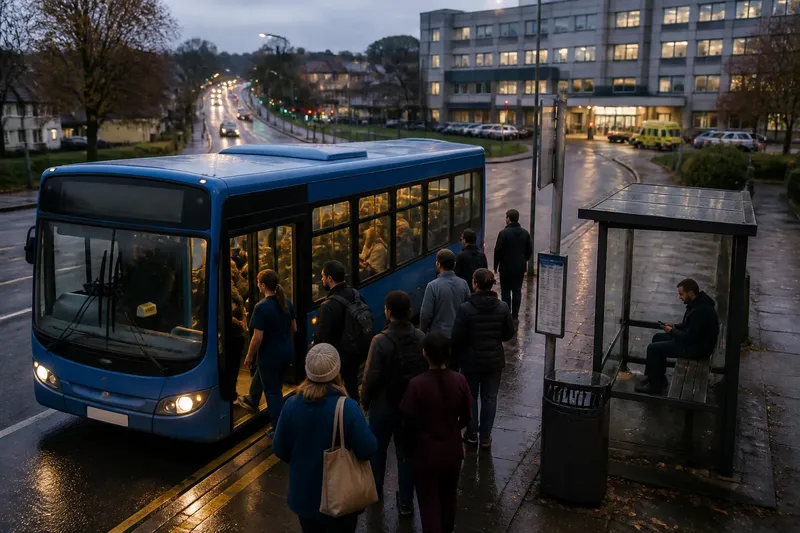
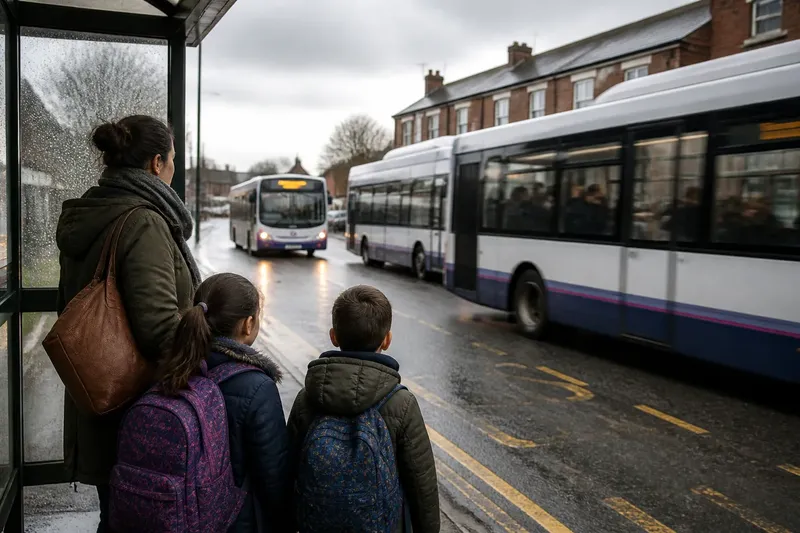
A council starts a free evening bus on two routes for a short trial. Passengers board, drivers report a stop that is hard to reach, and residents send comments. A pilot policy trial can reveal how a proposal works in that setting, but it cannot by itself settle whether the service should become permanent or expand across the area.
A pilot is a limited version of a policy, used to learn before a wider decision. Its findings are evidence, not a verdict. To assess them, ask what the trial was designed to observe, what conditions shaped it, and which unanswered questions matter to the next decision.
What pilots reveal
A carefully framed pilot can make the practical workings of a proposal visible. It may show whether staff can apply a new process, whether residents understand how to use a service, or where delays and access problems arise. Those observations can guide changes before a policy reaches more people.
A pilot may also surface outcomes officials did not expect. In the bus trial, passenger comments might identify a poorly placed stop or a gap between the last bus and the end of a late shift. Those observations suggest questions for a later version; they do not establish how many people would use a permanent service or whether it meets the policy’s wider purpose.
The reach of a pilot is like a key tried in one lock: the fit tells you something about that lock, not every door in the building. Location, participants, timing, staffing and nearby services shape what the trial can show. These conditions belong in the evidence, not in a footnote treated as irrelevant background.
Limits of trial evidence
A short or small trial can be useful for spotting operational snags. It is less able to show how a policy will behave as circumstances change. A service may be manageable while extra staff are assigned to it, yet difficult to sustain within ordinary workloads.
Who takes part matters. People who volunteer may be more interested or better placed to participate than those who do not. If a trial runs in one neighbourhood, its results may not reflect places with different travel patterns, language needs or access to alternatives. Differences between the trial setting and the wider population limit what can reasonably be inferred.
There is also a difference between observing activity and establishing impact. Passenger numbers show that people used a bus; on their own, they do not show that the service improved access to work, reduced isolation or changed travel choices. To assess those aims, decision-makers need to state the intended outcome and consider evidence that bears on it.
Questions about pilot evidence?
Does a successful pilot prove the policy works?
It shows that the tested version operated successfully under the observed conditions. Whether it achieved the intended public outcome, and whether that result would carry over elsewhere, requires separate consideration.
Can a failed pilot still be useful?
Yes, if the trial clarifies what went wrong and why. A fixable timetable problem points to a different next move from evidence that the service is inaccessible to the people it was meant to reach.
What does representative mean for a pilot?
It means the people, places and conditions in the trial resemble the setting where officials want to apply its lessons, in ways relevant to the policy. The report should explain those similarities and differences rather than simply describing the trial as typical.
When should a pilot be extended?
An extension can make sense when a specific uncertainty remains and further observation could address it. Continuing without a defined question may add activity while leaving the central decision no clearer.
A routine for review
Officials and residents can use a simple routine to keep a pilot’s evidence in proportion. Each stage should connect the trial to a decision rather than treating continuation as automatic.
- Before launch: Check that the policy aim, intended users and trial question are stated. If they are clear, decide which observations could answer the question; if not, clarify them before starting.
- During the trial: Check how the service is delivered, who can access it, and which disruptions or adjustments occur. If these details are recorded, separate them from evidence about wider outcomes; if not, begin an operational record and note what is missing.
- At review: Check the observed results against the stated aim, including missing groups, unusual conditions and gaps in the information. If the evidence addresses the aim, assess its limits; if it does not, identify whether more observation or a different method is needed.
- Before expansion: Check which lessons may transfer and which depend on the trial setting. If routes or staffing differ, adapt the proposal or gather evidence in a more relevant setting; if they are similar in the respects that matter, explain why a wider decision is reasonable.
- Before continuation: Check whether officials have described what would be monitored and what could prompt revision. If those conditions are clear, proceed with a review plan; if not, define them before treating continuation as the default.
- In the public report: Check that the original question, places covered, participants and unobserved issues are described. If these are present, readers can judge the evidence’s reach; if they are absent, ask officials to disclose the limits before relying on the recommendation.
Say a council’s evening-bus pilot attracts regular passengers but runs only near a large hospital. The invented starting information is that officials know the route, the service hours and that some passengers work late; they do not yet know whether other routes have similar shift patterns or transport options. They first record those differences for the hospital route, then compare the proposed routes with the same questions about shift times and alternatives. If another route has similar late shifts and few alternatives, the council has a reason to consider a further trial there; if its shifts end earlier or other transport is available, the hospital route’s use alone does not support copying the service. The resulting decision is to distinguish routes for further consideration, rather than assuming one trial settles the choice for every area.
From evidence to decision
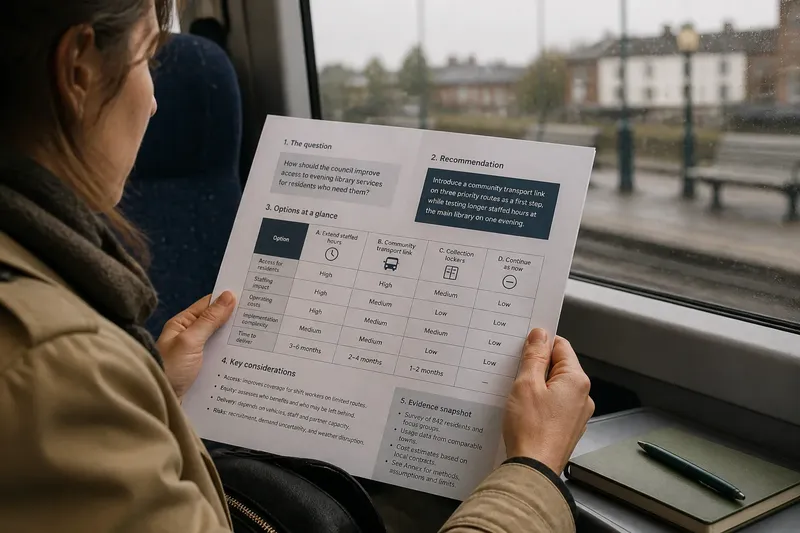
When a pilot report is published, look for the original question, the period and places covered, who took part, and what was not observed. A useful report separates direct observations from interpretations and explains important limitations in plain language. If it recommends expansion, readers can ask what supports that recommendation and which conditions might differ elsewhere.
Policy choices rarely wait for perfect information. The task is to match the decision to the strength of the evidence and to be candid about uncertainty. A pilot policy trial may support refining a service, gathering further evidence or considering a wider rollout. The appropriate response depends on what the trial actually established.
A report is most useful when it leaves decision-makers with a precise account of what was learned, what remains unresolved and what observation could answer the next question. When reading a pilot policy trial, check whether its proposed next move follows from the evidence and its limits; that makes later choices easier to scrutinise, even if the policy itself must change.