The Policy Brief Before the Policy Debate
A policy brief makes a proposal easier to examine by clarifying its question, options and evidence, while helping readers spot what its compact format leaves out.
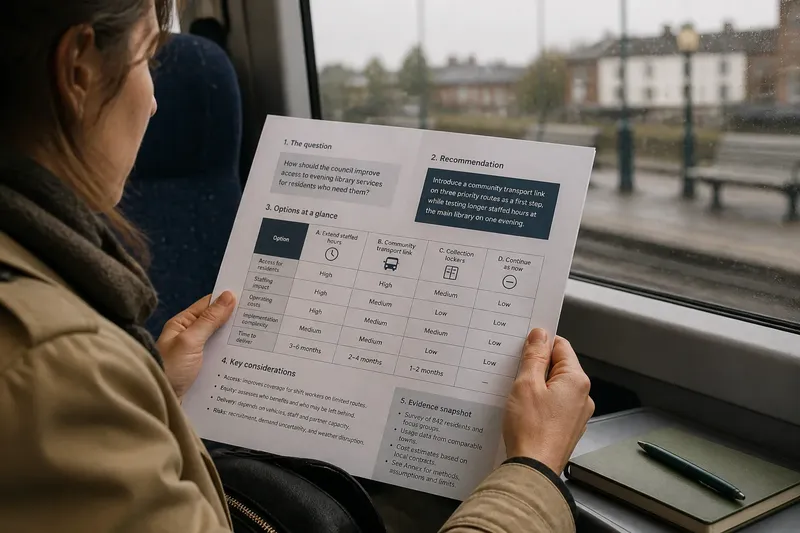
A committee member opens a policy brief on a train and reads its heading, recommendation and comparison table before reaching the station. That quick encounter shows why a policy brief is useful: it gives readers a shared starting point before debate begins. Its compact form can clarify the choice, but it can also make an unsettled question look tidier than it is.
Policy brief purpose
A policy brief is a short document designed to help a particular audience understand a public question and consider possible responses. It usually identifies a problem, sets out options and gives reasons for a recommendation or for further discussion. Its format varies by institution and purpose.
The brief acts as a bridge between detailed analysis and the meetings where choices are discussed. A full report may contain methods, background documents and qualifications that a busy reader cannot readily hold in mind. A brief selects some of that material and arranges it for decision-making.
Selection is not neutral. The drafter decides which question leads, what counts as an option, which evidence appears in the main text and what is left for an annex. These choices shape the discussion before anyone speaks in the room.
Think of the document as a small tray for a large meal. It helps a reader see the main items together, but it cannot hold everything that went into preparing them. A concise format is useful when readers also ask what sits beyond its edges.
Questions set boundaries
The opening question defines the work a brief can do. “How should the council improve access to evening buses?” invites comparison among possible responses. “Should the council expand evening buses?” has already narrowed the discussion towards one type of response.
Neither wording is automatically wrong. A focused question can make a brief usable, especially when the decision-maker has a specific remit. But readers should notice whether the question concerns the public problem, the choice of policy instrument or the design of a proposal. Those are different tasks.
A useful question names the decision, the population or service affected, and the relevant boundary where possible. It might ask how to improve access for shift workers on routes with limited evening service, rather than asking vaguely how to make transport fairer. The narrower wording is easier to examine, though it may exclude other groups or causes that deserve attention.
Watch for assumptions hidden in the wording. A question about how to “restore” a service implies that restoration is the goal; a question about “reducing misuse” presumes that misuse is established and central. The brief should make such premises visible rather than present them as settled facts.
Options share a basis
A brief may compare several options, including keeping current arrangements, changing a rule, offering a service or combining approaches. The list matters less than whether the alternatives respond to the same question. An option too vague to describe or compare can create the appearance of choice without offering a real one.
Comparison is clearest when each option is considered against the same concerns. These might include who benefits, who bears costs, what must be administered and what could prevent implementation. The relevant concerns depend on the decision; an even-looking table does not make unlike options equivalent.
Say a town is considering better evening access to its library. In this invented situation, the starting point is a brief comparing extended staffed hours, a community transport link and book collection lockers. If the brief considers access, staffing and delivery for all three, readers can see where the approaches differ. If it gives one option detailed cost information and calls another merely “innovative”, readers have reason to question whether the comparison is even.
A “do nothing” or “continue as now” option can be informative, but it should be described accurately. Current arrangements are not an empty baseline: they may have costs, consequences and beneficiaries. A combined option should also explain what it combines and why, rather than serving as a catch-all recommendation.
Reasons and evidence
A brief’s case for an option should show the connection between the evidence and the expected result. It can summarise what is known, identify uncertainty and explain why the evidence matters to the decision. Placing a weak basis beside a confident recommendation does not make the basis stronger.
Look for distinctions among observed facts, forecasts, assumptions and judgements. A statement that a service has a long wait differs from a prediction that a new arrangement will shorten it. A judgement that the improvement is worth the administrative burden differs from both. Clear writing marks these distinctions so readers can debate the reasoning without mistaking one kind of claim for another.
Space is limited, so a brief may point to fuller material rather than reproduce it. Readers should be able to identify where supporting information comes from and what limits apply. If the brief gives a conclusion but no route to the underlying material, it is harder to assess how much weight that conclusion deserves.
Evidence also has a scope. Information about one locality, group or period may illuminate a choice without answering every question about it. A compact document should not imply that evidence transfers automatically to another setting. A short note about its reach can be more useful than another paragraph of confident summary.
Questions readers ask?
Why is a policy brief so short?
Its length is intended to make a decision question and its main considerations accessible without requiring readers to begin with a full technical report. Shortness is a design constraint, not evidence that the underlying problem is simple.
Can a policy brief be neutral?
A brief can distinguish evidence from recommendation and represent competing options fairly, but choices about scope and emphasis still shape its account. Readers can judge its balance by checking whether alternatives receive comparable treatment and important assumptions are explicit.
What belongs in an annex?
An annex can hold material needed for scrutiny but too detailed for the main text, such as fuller methods, assumptions or option descriptions. It should support the central account, not conceal information that would change how readers understand the recommendation.
Does a recommendation settle the debate?
No. It states the drafter’s or institution’s preferred course and reasons, while the authorised decision-maker may weigh those reasons differently or request more work. A recommendation is an input to a decision, not the decision itself.
Format shapes attention
Headings, tables and summary boxes affect how an argument is received. A recommendation at the top can orient readers quickly; a table can make differences easier to spot; a bold warning can draw attention to uncertainty. Each device directs attention, so notice what receives visual priority and what is relegated to smaller print or a note.
Tables are useful when they compare like with like. They become less helpful when one cell has to carry a complex qualification, or when a neat row makes uncertain judgements appear directly comparable. Plain prose can explain a distinction that a grid flattens. A brief works best when it uses each form for what it handles well.
Terms also need care. Words such as “efficient”, “targeted” and “affordable” can sound precise while leaving the standard unstated. A brief should say, where relevant, efficient in relation to which resources, targeted towards which group, or affordable for whom. Without that explanation, readers may share a word but disagree about its meaning.
Checks before debate
Before a meeting, a reader can use these checks to identify what the brief is asking the room to decide. Each observation points to a practical decision about what to clarify next.
- Check whether the opening question names a problem, a policy approach or the design of one approach. If it names the decision clearly, use it to frame discussion; if it embeds a preferred answer, ask for a broader question.
- Check whether every option is described in plain language. If each is concrete enough to compare, proceed to the criteria; if one is vague or missing, ask for a fuller description or an additional option.
- Check whether current arrangements are included and described. If their consequences are stated, use them as a clear baseline; if they are treated as cost-free or consequence-free, ask what continuing them entails.
- Check whether the brief separates observations from forecasts, assumptions and value judgements. If it does, debate each claim on its own terms; if not, ask the drafter to label the claims before relying on them.
- Check whether every option is assessed against the same relevant concerns. If the criteria are shared, compare the resulting trade-offs; if they differ without explanation, request a consistent comparison or a reason for the difference.
- Check whether references lead to supporting material and state its limits. If the source and scope are clear, judge how well they fit the decision; if they are absent or hard to follow, ask for the material or a clear account of the gap.
- Check whose experience and working conditions appear in the account. If affected groups and delivery staff are represented, consider their implications for the options; if important perspectives are missing, ask whose account should inform the decision.
Bring the resulting questions into discussion rather than treating the brief as a verdict. A reader might ask why one option was excluded, what uncertainty matters most, or who would carry a new administrative burden. These are precise questions about the document’s reasoning, not objections to brevity itself.
Keep scope in view
A policy brief is most useful as a map to a decision, not as a substitute for the territory. It can make the question, options and reasons easier to discuss, while leaving detailed evidence, competing values and implementation choices for fuller examination. When reading a policy brief before debate, track both what the format brings into focus and what it places beyond the frame.
Ask what would have to be true for the preferred option to make sense. That question exposes assumptions a meeting may need to examine and helps participants decide whether the brief has prepared them to weigh the choice.