From a Public Problem to a Policy Proposal
Learn how framing a public problem clarifies who is affected, separates symptoms from possible causes and keeps policy options open for fair comparison.

At a bus stop, a parent watches two full buses pass before a third arrives late. “There aren’t enough buses,” she says. Framing a public problem means turning that concern into a clear account of what is happening, who is affected and what public action might address—without settling on a remedy too soon.
The same scene could be described as unreliable scheduling, overcrowding on one route or a gap between homes and services. Each description directs attention towards different choices. A useful frame is specific enough to guide discussion, yet open enough to allow more than one plausible response.
From concern to problem
A concern is a signal that something may be wrong: queues are growing, a service is hard to reach or residents feel excluded from a local decision. A policy problem is a more deliberate statement. It identifies an undesirable condition, connects it to a group or setting and explains why collective action may be appropriate.
A concern can contain several problems at once. A complaint about a town centre might refer to empty shops, unsafe crossings, poor public transport or a lack of places to sit. These conditions may affect different people and have different causes. Treating them as a single problem can obscure both who is affected and which responses are available.
A first framing might read: “Residents who rely on the east-side bus route cannot reach the health centre reliably during weekday mornings.” It names a group, service and time without assuming why the journey is difficult or prescribing a solution. That restraint keeps the problem distinct from the proposal.
Set clear boundaries
Every policy problem has boundaries. Place, time, people and the condition itself need some definition. “Access to healthcare” covers more than “getting from the north estate to the local clinic by public transport”. The narrower statement is easier to investigate, but it could miss people facing the same barrier elsewhere.
Boundaries are choices, not merely technical details. A review limited to bus punctuality may leave out missed train connections. A review of clinic access that considers only travel time may overlook appointment hours that people can attend. State what the frame includes and what it leaves outside.
- Who is affected? If accounts point to a distinct group, name it; if experiences differ within the group, describe those differences rather than treating everyone alike.
- Where does it happen? If the stated area matches how people use the service, retain it; if journeys cross its boundary, widen or qualify the scope.
- When does it happen? If the condition is tied to a particular time or circumstance, include it; if it occurs more broadly, avoid wording that implies a narrow window.
- What is the condition? If people cannot do something or a recurring event affects them, describe that observable experience; if the wording names a remedy, rewrite it to state the condition instead.
- What is excluded? If a connected concern could change how the issue is understood, note it for consideration; if it is outside the decision, state that limit and why.
- Whose experience is missing? If the people most affected have not had a chance to contribute, seek an appropriate way to hear from them; if they have, record any remaining gaps in the account.
These checks expose decisions that broad phrases can hide. A boundary can be revised if it does not fit the experience being described.
Separate symptoms from causes
A visible condition is not necessarily its cause. Late buses might be linked to congestion, driver availability, an unsuitable timetable, road works or several factors together. Framing the issue as “buses are late” describes an experience. Framing it as “the timetable fails to account for school traffic” already assumes an explanation.
Keep three layers distinct. The condition is what people experience, such as arriving late for appointments. A contributing factor is something that may help produce it, such as a long gap between services. A policy lever is something a public body could change, such as the timetable or route. These layers may be related, but one should not be treated as proof of another.
This distinction matters because public bodies have different powers. An agency may control route planning but not the location of every clinic or the hours of every employer. A sound problem statement can describe the condition while leaving possible explanations open for examination.
Choose words carefully
Words shape who appears responsible and which responses seem reasonable. “People fail to attend appointments” directs attention towards individual behaviour. “Appointments are difficult to reach by public transport” draws attention to the service and the journey. Either may be relevant in a particular setting, but each gives the discussion a different starting point.
Labels can also make a group sound like the problem. Calling residents “hard to reach” may describe an administrative difficulty, yet it can imply that residents are the obstacle. Saying that existing outreach does not reach some residents focuses instead on the relationship between a service and the people it serves.
Prefer wording that can be checked against experience. “The system is unfair” may express a serious judgement, but it needs detail to guide a proposal: unfair in what way, for whom and against what expectation? A clearer account might identify a longer journey, fewer available appointment times or a different eligibility rule. People can then discuss the same condition while disagreeing about its importance.
Who defines the problem?
Officials may understand a service through administrative records; residents may notice the time, effort and uncertainty involved in using it. Practitioners may see constraints in delivery. These perspectives can reveal different parts of the situation. Formal language alone does not make one account complete.
Listening does not mean treating every complaint as equally representative. It means making space for relevant experience, recording differences and being clear about whose experience has not been heard. A meeting at an inconvenient time, for instance, may exclude people with the least flexible schedules. How information is gathered can shape the problem statement.
Participation needs a clear purpose. People might be asked to describe what happens, comment on a draft framing or weigh competing priorities. Those are different requests. If officials have already set the scope, they should say so. If residents can influence it, they should be able to see how their contributions affected the wording.
Check the framing
Before using a frame to compare responses, ask whether it names an observable condition, whether its boundaries are understandable and whether it assumes a cause that remains uncertain. Consider whether the group is too broad to show important differences or too narrow to represent the concern fairly.
“The bus service is failing” is forceful but vague. “Passengers on the east-side route cannot board the first bus that arrives during the morning commute” names a route, time and experience that could be investigated. It may still need clarification: does this happen to a shared group, and which passengers are affected? The aim is not to make every sentence technical. It is to make the issue discussable.
Say a council receives reports that families cannot reach a food support centre easily. It initially describes the issue as low attendance. After speaking with service users, it learns that some families arrive after closing because a connecting bus is unreliable. The council revises the framing: some families cannot reach the centre during opening hours using the available connection. Journey timing and opening hours now belong among the options for consideration, but the wording does not decide which should change.
A problem statement is like a map: it helps people see the decision area, but it does not show every detail of the territory. Its limits should remain visible so that a useful boundary is not mistaken for the whole public concern.
Questions about framing?
How narrow should a policy problem be?
Make it narrow enough to identify a condition, group and setting clearly. Keep connected concerns visible if leaving them out could distort the account or shift burdens onto people beyond its stated scope.
Can one problem have several causes?
Yes. A condition may arise from interacting factors, and the available information may not distinguish their influence. State what people experience separately from what remains a possible explanation.
Should the problem statement name a solution?
Usually, it should describe the condition and leave the response open. If a remedy appears in the wording, readers may mistake an assumption about cause or authority for part of the problem itself.
What if people disagree about the framing?
Record what each account includes and leaves out. People may still agree on the immediate scope while keeping uncertainty or competing interpretations explicit.
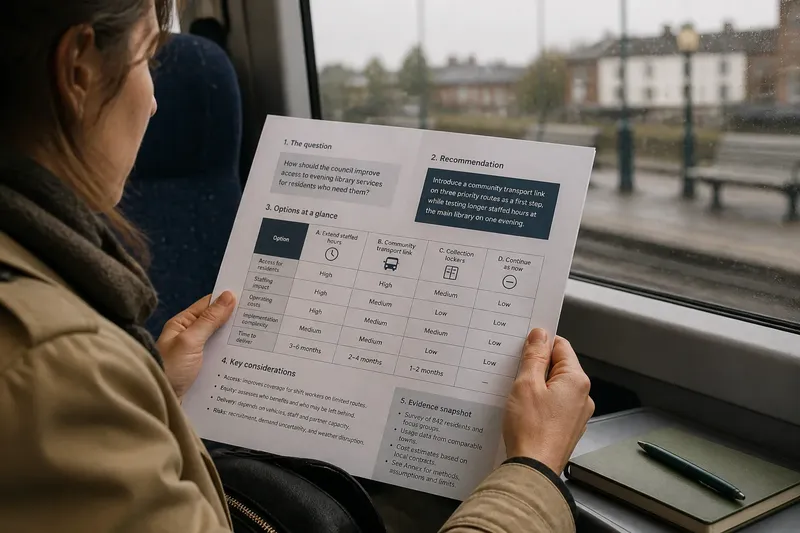
From frame to proposal
Once the problem is defined, the next task is to identify which parts might be changed through public action. A clear frame does not dictate one answer. It helps decision-makers ask whether a response addresses the stated condition or a nearby issue that is easier to describe.
If residents cannot reach a service at the time it is available, possible areas for consideration include transport connections, appointment arrangements or the service location. These options are not interchangeable. Each raises different questions about authority, access and consequences. The frame keeps them connected to the same public concern.
When reading a proposal, look for its stated problem before weighing its remedy. The gap between the two can reveal whether the response addresses the described condition or whether the framing has quietly shifted. That distinction helps keep debate focused on the decision people are actually being asked to make.